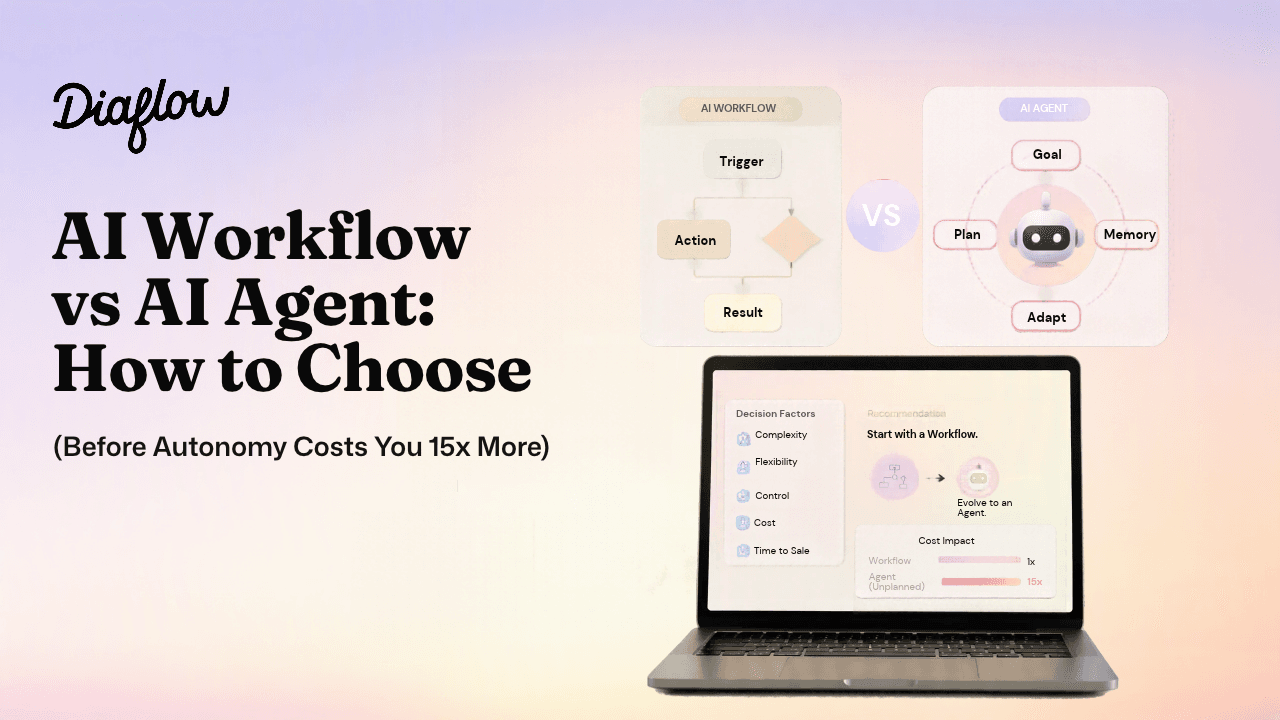
AI Workflow vs AI Agent: How to Choose (Before Autonomy Costs You 15x More)
9 OCT 2026
AI workflow vs AI agent comes down to who writes the plan. In a workflow, you do: the steps are fixed and the AI fills in specific gaps. In an agent, the AI does: it picks tools, checks results and retries until it reaches a goal.
That difference decides whether your automation ships or gets scrapped. Gartner expects over 40% of agentic AI projects to be cancelled by the end of 2027, citing rising costs, unclear value and weak risk controls (Gartner).
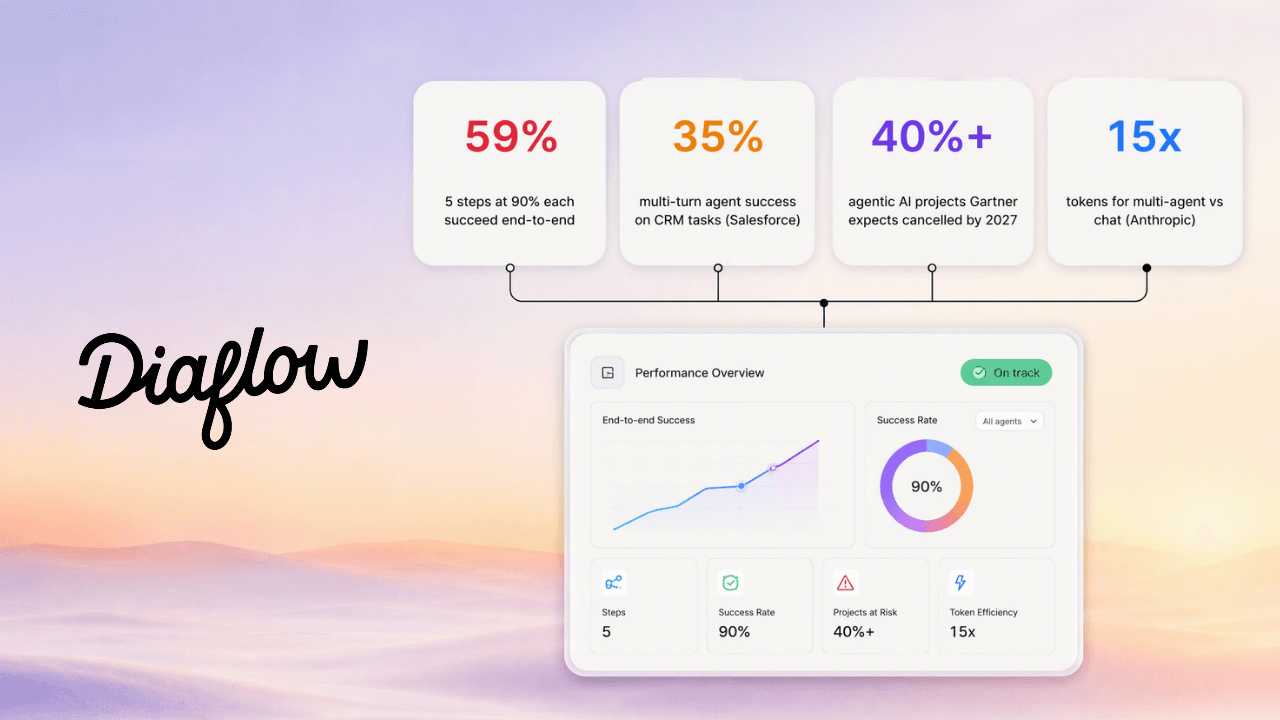
Four proof points: 59% end-to-end success at 5 steps, 35% multi-turn agent success, 40%+ of agentic projects cancelled, 15x token cost
What are three key takeaways for readers?
- Start with a workflow. If you can list the steps, you don't need an agent. Salesforce's benchmark found top agents above 83% on workflow-execution tasks, but only about 35% on multi-turn business tasks (arXiv).
- Autonomy has a price, in reliability and in tokens. At 90% accuracy per step, 10 steps succeed only about 35% of the time. Agents use about 4x the tokens of chat, and multi-agent systems about 15x (Anthropic).
- Add agents only where the path can't be predicted. Keep a workflow as the backbone, and give the agent a capped loop with human approval on anything irreversible.
What is the difference between an AI workflow and an AI agent?
| Feature | AI workflow | AI agent |
|---|---|---|
| Who decides the steps | You, in advance | The model, while running |
| Typical calls per run | 1 to 3 | 10 to 30+ |
| Best for | Extraction, routing, templated content, reports | Open-ended research, multi-tool troubleshooting |
| Main risk | Rigid when requirements shift | Compounding errors, runaway cost |
A workflow behaves like a pipeline with checkpoints. Take a weekly marketing report: ingest metrics, ask the model only for {metric, value, delta, insight}, apply fixed chart styles, then route to approval. The model never chooses the chart type or who receives it.
A real agent shows four behaviors: it chooses tools, iterates after failures, evaluates its own result against acceptance criteria, and stops at a goal, a budget cap or a human approval. If a product does none of these, it's a chatbot or a workflow with a new label. Gartner calls this "agent washing" and estimates only about 130 of the thousands of vendors claiming agentic AI are real (Tech Research Online, citing Gartner).
Capability gaps are real too. In Carnegie Mellon's TheAgentCompany benchmark, the best agent completed about 30% of realistic workplace tasks autonomously (arXiv). Anthropic's own advice is to find the simplest solution possible and add complexity only when needed (Anthropic).
In short: if the steps fit on a whiteboard, build a workflow. Reach for an agent when you can't draw the path in advance.
How do you decide between an AI workflow and an AI agent?
Ask yourself four questions. Follow YES or NO from the top.
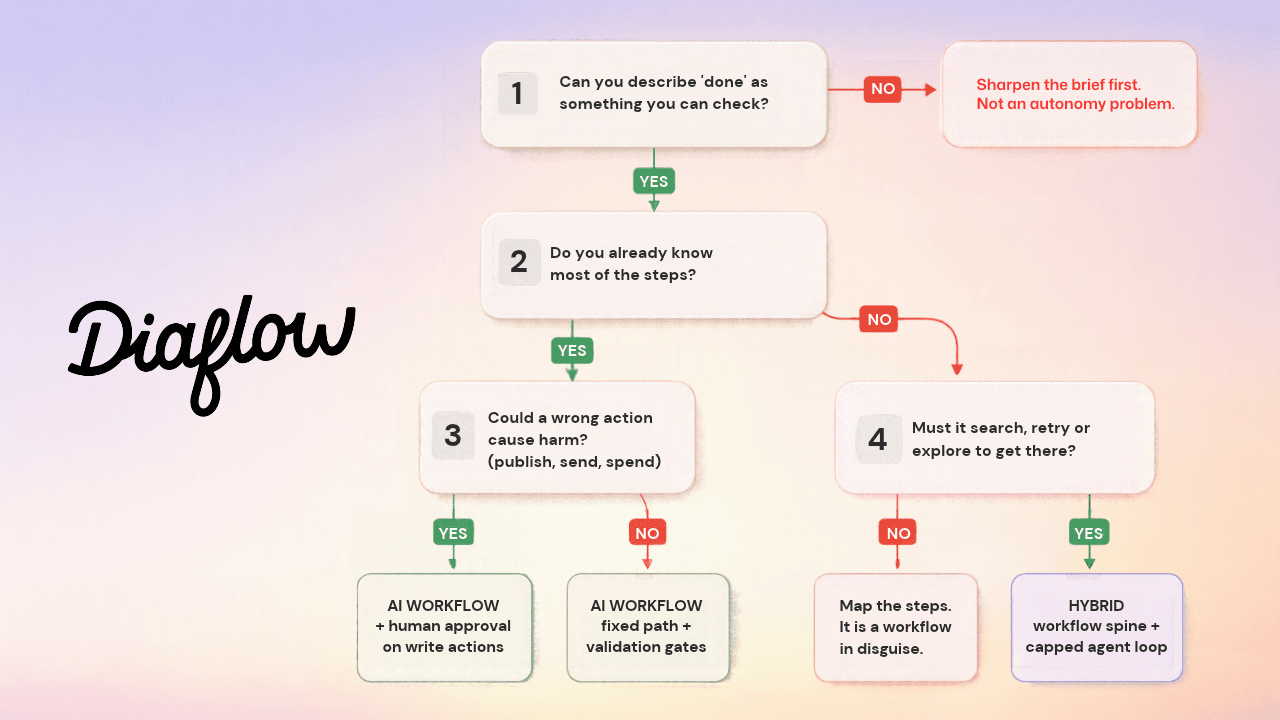
Decision tree with four questions: can you define done, do you know most steps, could a wrong action cause harm, must it search or retry. Outcomes: sharpen the brief, AI workflow, AI workflow with approval, map the steps, or hybrid
In plain text:
- Can you describe "done" as something you can check? No: sharpen the brief first. Yes: go to question 2.
- Do you already know most of the steps? Yes: go to question 3. No: go to question 4.
- Could a wrong action cause harm (publishing, sending, spending)? Yes: use a workflow with human approval on those steps. No: use a plain workflow with validation gates.
- Must it search, retry or explore to get there? Yes: use a hybrid, a workflow spine with a capped agent loop. No: map the steps, because it's a workflow in disguise.
Notice that no path ends at a fully free-running agent. That's deliberate.
How do reliability and error rates change?
Errors compound across steps. If each step is right 90% of the time, five steps succeed 0.9^5 = 59% of the time, and ten steps only 35%. A workflow breaks that curve by validating each step and stopping early when output is malformed.
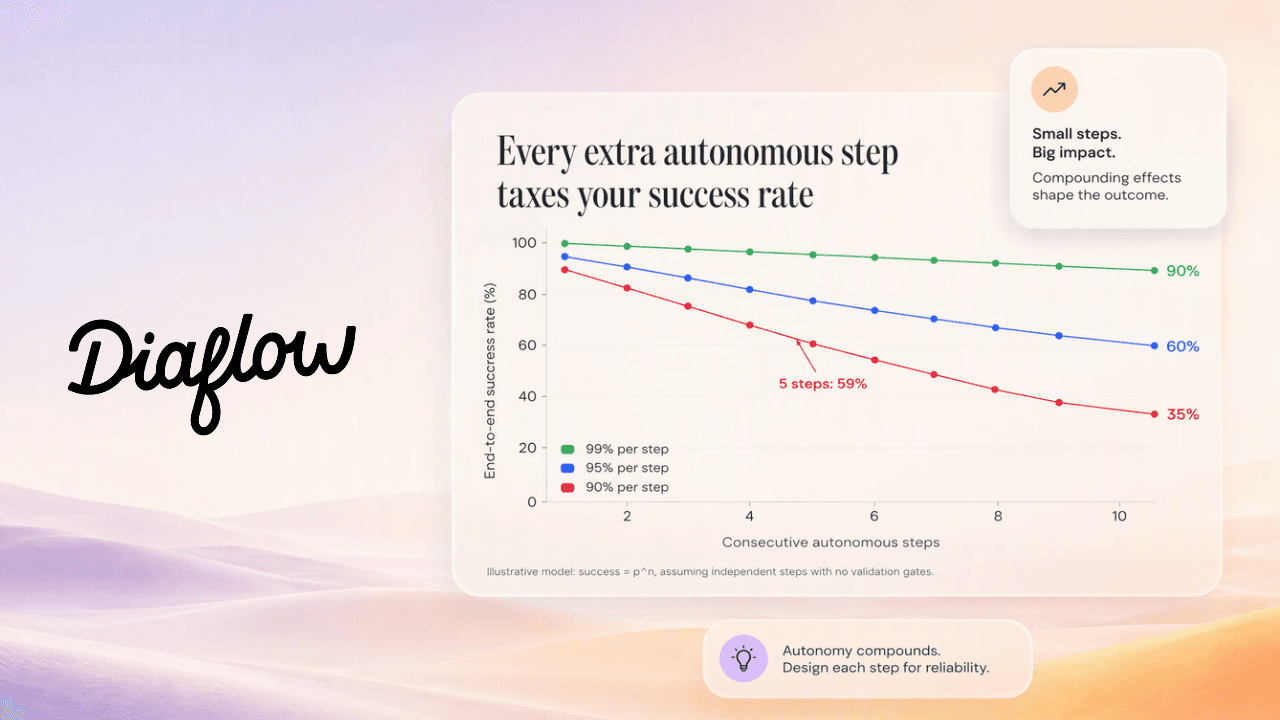
Line chart of end-to-end success rate falling as autonomous steps increase, at 99%, 95% and 90% per-step accuracy
In short: 90% per step sounds safe. Over ten unchecked steps, it fails two runs out of three. Add a validation gate between steps.
What does cost and latency usually look like?
A workflow typically needs one to three model calls with predictable latency. An agent loops, carries more context and tries alternatives, so it uses about 4x the tokens of chat, and multi-agent systems about 15x (Anthropic). Every failed attempt adds a "retry tax" of extra calls.
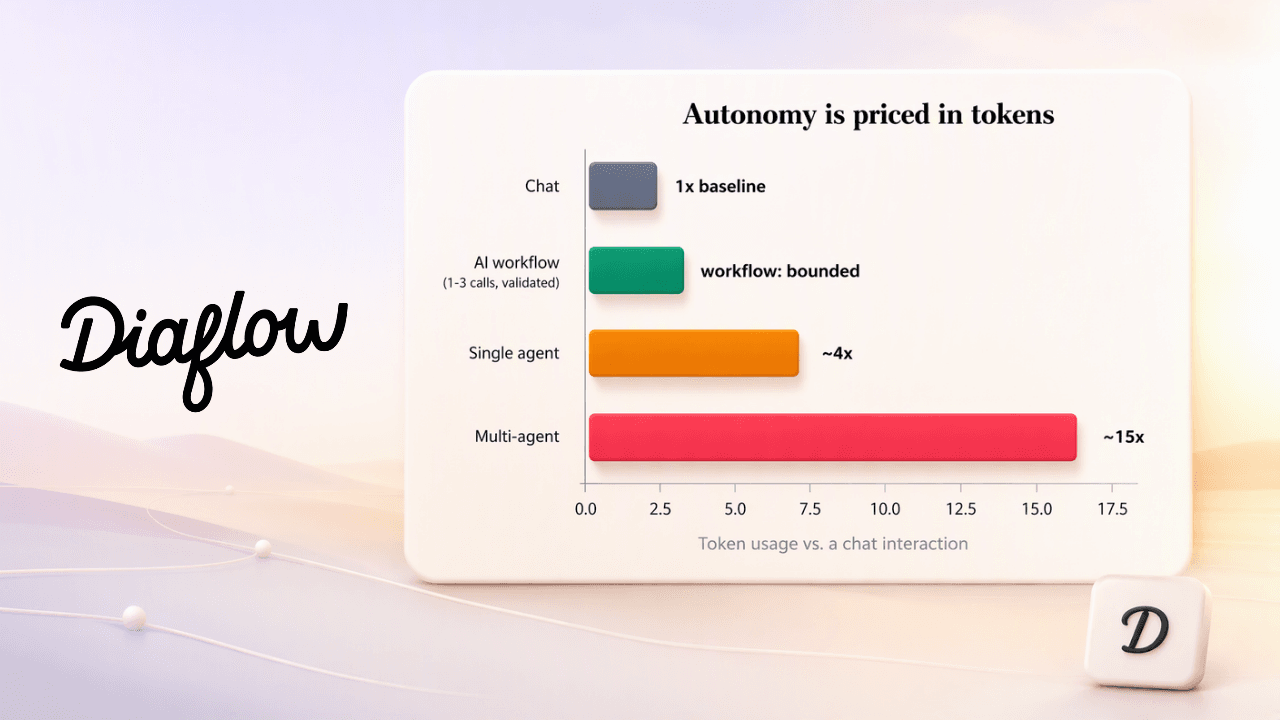
Bar chart of token usage versus chat: workflow bounded, single agent about 4x, multi-agent about 15x
That's not a reason to avoid agents. In the same study a multi-agent setup beat a single agent by 90.2% on breadth-first research, so the extra spend pays off when the task is valuable and open-ended.
The short answer: default to a workflow and budget per run. If you do use an agent, set a hard cap on turns and spend, and only on tasks worth several times the cost of a workflow.
Which option should you start with, based on your role?
| If you are... | Start with | Add agent loops when... |
|---|---|---|
| Growth or marketing lead (reports, campaign packs, ad variants) | AI workflow with approval gates | Briefs change midstream and assets need open-ended research |
| Solopreneur shipping AI mini-apps | AI workflow with hard spend caps | A task truly needs search and retry, and your pricing survives 4x tokens |
| Automation or ops engineer | Hybrid: orchestrator plus a capped agent module | Cross-tool troubleshooting can't be written as if/else |
How do hybrid AI systems reduce risk?
A hybrid keeps deterministic orchestration as the backbone and lets an agent loop handle only the uncertain parts. That preserves approvals, audit trails and predictable spend. Gartner's guidance points the same way: agents for decisions, automation for routine workflows, assistants for simple retrieval (Tech Research Online).
Hybrid system combining workflow orchestration with a controlled agent tool loop
A safe hybrid has five parts:
- Orchestrator: runs the known steps and decides when to call the agent.
- Tool registry: separates read tools from write tools.
- Approval gates: a human signs off on publishing, emailing or budget changes.
- Caps: maximum turns, time and token spend.
- Logs: every tool call and stop reason is recorded.
For long tasks, summarize older turns into a compact state and drop stale tool output, so the agent stays fast and cheap without losing its constraints.
Build the hybrid in Diaflow
Diaflow lets you put structured workflows and tool-calling agents on one canvas.
- Agent tool-calling: goal-driven loops that pick tools and check their own output.
- One visual canvas: logic gates, API connectors and databases next to an agent loop.
- Guardrails: approval steps, role-based access and audited execution traces.
- Model-agnostic: connect OpenAI, Anthropic, Gemini or your own endpoint.
Start building with Diaflow or join our Discord to compare pipelines with other builders.
FAQ
When should I start with an AI workflow?
When the end result is clear and most steps can be written as a checklist, or when you need approvals, predictable cost and strict formatting. Campaign briefs, ad variant matrices and recurring reports are typical.
What is the simplest test for needing an agent?
Ask whether the system must try different approaches and learn from tool feedback. If the work needs search, experimentation or retries across tools, an agent loop is justified. If it's an if/else tree, it isn't.
How do I control risk in agentic systems?
Separate read and write permissions, require human approval for irreversible actions, cap turns and spend, and add acceptance tests so the agent can't claim success without meeting them.
Is an AI agent more accurate than an AI workflow?
Not by default. Salesforce's CRMArena-Pro found leading agents at about 58% single-turn and 35% multi-turn success, while workflow-execution tasks exceeded 83% (arXiv). Accuracy depends on how well the task is structured.
Where can I learn to build agent workflows safely?
Start with how to build an AI agent, then compare it with a workflow-first approach in process automation and AI in marketing automation.