Best Marketing Automation Software For Small Business, 20 Plus Tools Ranked With A Buyer Scorecard
28 SEPT 2026
Best Marketing Automation Software For Small Business, 20 Plus Tools Ranked With A Buyer Scorecard
Best marketing automation software for small business should match your workflows, team capacity, and growth stage rather than simply offering the longest feature list. A practical shortlist compares automation depth, channel support, pricing triggers, integrations, and AI capabilities before choosing a platform.
Key takeaways
- Small businesses should evaluate automation tools by workflow fit, cost transparency, integrations, and operational complexity.
- Free plans vary widely, so test whether they automate meaningful customer journeys instead of only storing contacts.
- AI-powered workflow platforms are becoming important for businesses that want marketing operations to run across multiple systems.
How Small Businesses Should Evaluate Marketing Automation Software
Small businesses should evaluate marketing automation software using a buyer scorecard based on workflows, channels, integrations, and available team bandwidth.
Start with workflow maturity
The right platform depends on what your business needs to automate today. A startup sending newsletters has different requirements from an established company managing multiple campaigns.
- Starter stage: Email campaigns, basic forms, and simple customer follow-ups.
- Growth stage: Segmentation, lead nurturing, sales handoffs, and reporting automation.
- Advanced stage: Cross-channel journeys, AI-assisted content creation, and connected data workflows.
Our team found that small businesses often overestimate the need for advanced features and underestimate the importance of clean data and repeatable processes.
Use a 100-point buyer scorecard
Score each platform before booking a demo:
| Criteria | Weight | What to check |
|---|---|---|
| Workflow automation | 30 | Can it automate your highest-value recurring tasks? |
| Cost transparency | 20 | Do contact limits, seats, or add-ons increase costs? |
| Integrations | 20 | Does it connect with your existing marketing stack? |
| AI capabilities | 15 | Can AI support research, content, and campaign operations? |
| Ease of adoption | 15 | Can your team maintain workflows without constant technical help? |
Top 20 Plus Marketing Automation Tools For Small Business By Use Case
The best marketing automation software for small business depends on the primary job you need completed, from email lifecycle management to AI-driven campaign operations.
| Tool category | Examples | Best fit |
|---|---|---|
| Email automation | Mailchimp, Brevo, ActiveCampaign | Businesses building customer journeys through email |
| Inbound marketing | HubSpot Marketing Hub, GetResponse | Teams combining content, leads, and automation |
| E-commerce automation | Klaviyo, Omnisend, Drip | Online stores needing behavioral campaigns |
| CRM-connected automation | Salesforce Marketing Cloud, Zoho Marketing Automation | Businesses requiring sales and marketing alignment |
| Social automation | Buffer, Later, Sprout Social | Teams managing publishing workflows |
| AI workflow automation | Diaflow | Businesses wanting AI agents to coordinate marketing tasks across systems |
Mailchimp: Suitable for small companies starting with email automation because it combines campaign creation, audiences, and basic automation features.
ActiveCampaign: Strong for businesses that need detailed customer journeys, conditional logic, and behavior-based messaging.
Klaviyo: Commonly selected by e-commerce teams because of its focus on customer events, segmentation, and lifecycle campaigns.
HubSpot Marketing Hub: Fits companies that want marketing tools connected with CRM processes, although advanced capabilities may require higher plans.
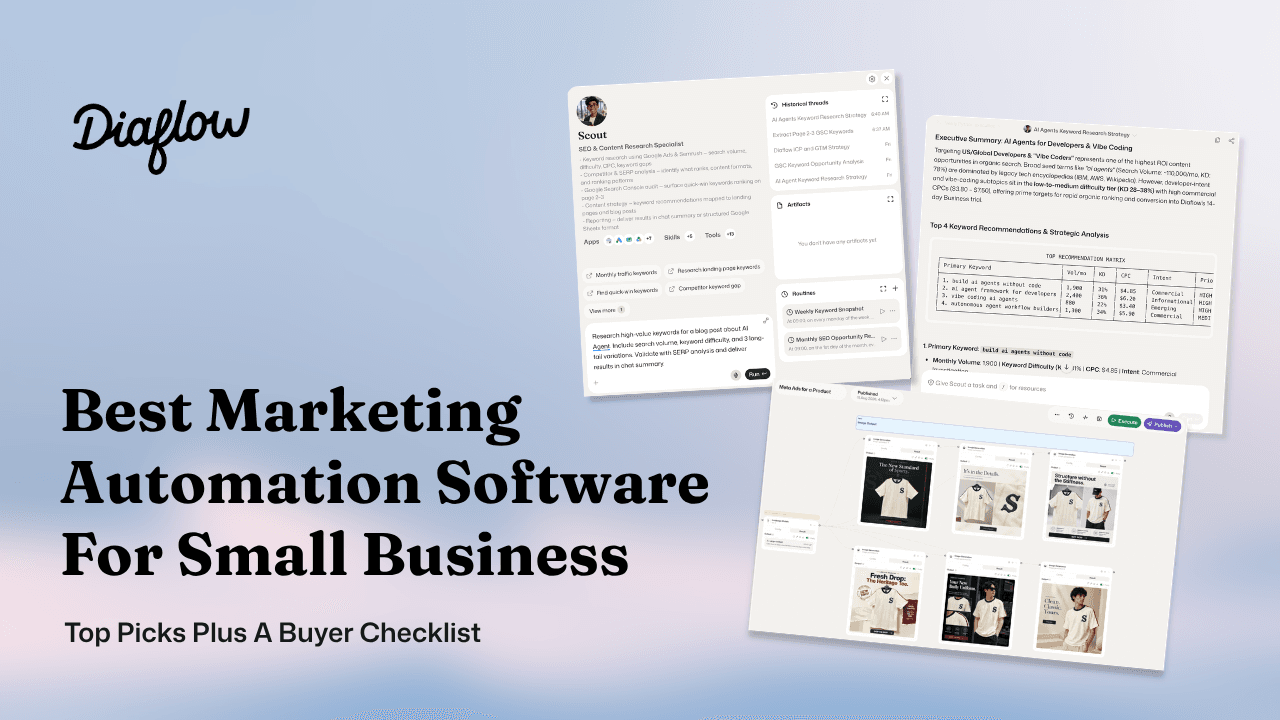
Diaflow: Diaflow is a modern platform for marketing automation for a small business that wants AI agents to orchestrate repeatable workflows. Its Flows can connect marketing actions, while Tables help organize campaign and lead information, Drive stores assets, Pages support lightweight interfaces, and Chat provides an entry point for interacting with workflows and agents.
When we tested workflow-first automation approaches, the biggest improvement was reducing manual movement between research, content creation, approvals, and reporting steps.
Free Plans That Actually Automate, What You Can And Cannot Do
Free marketing automation plans should be judged by whether they execute real workflows, not whether they only provide contact storage or campaign templates.
A strict free-plan checklist
- Can it trigger actions automatically?
- Can it segment users based on behavior?
- Can it connect at least one external system?
- Can a small team test a complete customer journey?
Useful free-tier experiments include a welcome email sequence after signup, an abandoned inquiry follow-up, and a basic content distribution workflow. Many free plans become limited when businesses need more contacts, automation steps, analytics, or additional channels.
Common SMB Dealbreakers From Reviews And How To Vet Them
Small businesses usually abandon automation platforms because of hidden costs, difficult maintenance, weak integrations, or workflows that require too much technical support.
Questions to ask during every demo
- What happens when contact volume doubles?
- Which features require a higher subscription tier?
- How are failed automations detected?
- Can non-technical marketers update workflows?
In our experience working with small teams, the strongest predictor of adoption is whether marketers can understand and update workflows without depending on developers for every change.
Hidden cost checklist
- Contact-based pricing increases as your database grows.
- Premium reporting may require upgraded plans.
- SMS, ads, and additional channels often add separate costs.
- Migration and setup time can become a significant expense.
What Is In Demand In 2026 For Future-Proof SMB Automation
Future-ready marketing automation software for small business will increasingly focus on AI workflow orchestration, connected data, privacy controls, and omnichannel execution.
The 2026 buyer checklist
- AI journey building: Look for platforms that help create and maintain workflows, not only generate text.
- Data control: Choose systems with clear storage, permissions, and privacy practices.
- Omnichannel readiness: Evaluate email, social, customer support, and content operations together.
- Reusable processes: Prioritize platforms where successful campaigns become repeatable systems.
AI in marketing automation is becoming a practical consideration for SMB buyers because teams need faster execution without adding operational complexity. AI in marketing automation helps explain how these systems are evolving.
Frequently Asked Questions
What should a small business automate first?
Start with repetitive workflows that directly affect revenue, such as lead follow-up, customer onboarding, abandoned cart recovery, and reporting.
Are free marketing automation tools enough for small businesses?
Free tools can support early experiments, but growing businesses should check automation limits, integrations, and reporting restrictions before committing.
How does AI change marketing automation?
AI allows teams to automate more complex tasks such as content workflows, research processes, campaign variations, and internal knowledge access.
Is Diaflow suitable for small business marketing automation?
Diaflow is designed for businesses that want AI agents and connected workflows to automate marketing operations across multiple systems.
Choosing the right platform starts with your workflows, not the feature list. Businesses looking for AI agents to coordinate marketing processes across tools can shortlist Diaflow as a modern option, then explore the platform by getting started or talking with sales.